From Single-Agent to Multi-Agent: A Practical Guide
How to architect your way from a single AI assistant to a team of collaborating agents—patterns, frameworks, and practical lessons from real multi-agent deployments.
From Single-Agent to Multi-Agent: A Practical Guide
Most teams start with one agent. A customer service bot. A coding assistant. An agent that summarizes reports. These work well for focused, well-defined tasks. Then someone asks: can it also check the CRM, update Jira, draft the follow-up email, and schedule the meeting?
At some point, the single agent becomes a monolith—trying to do too many things, with too many tools, in too large a context window. That's when multi-agent architectures start making sense.
This guide walks through when to make the jump, how to structure the transition, and the practical tradeoffs between today's major multi-agent frameworks.
When a Single Agent Isn't Enough
A single agent struggles when:
Context windows overflow: Tasks that require processing large volumes of data, running multiple sequential lookups, or maintaining long conversation histories push against model limits.
Tasks require parallel work: If step A and step B don't depend on each other, a single agent runs them sequentially. A multi-agent system can parallelize.
Specialization matters: A generalist agent writing SQL, Python, and legal prose while also managing calendars will do each moderately well. Specialized agents do their domain well.
Different reliability requirements: Some tasks need deterministic, audited execution. Others benefit from creative, open-ended reasoning. One agent architecture can't optimize for both simultaneously.
Long-running workflows: Tasks that span hours or days—a multi-step procurement process, an ongoing research project—need state management beyond what a single context window provides.
The rule of thumb: when you find yourself adding the 10th tool to a single agent and its performance is degrading, it's time to think about decomposition.
The Core Multi-Agent Patterns
Pattern 1: Orchestrator + Specialists
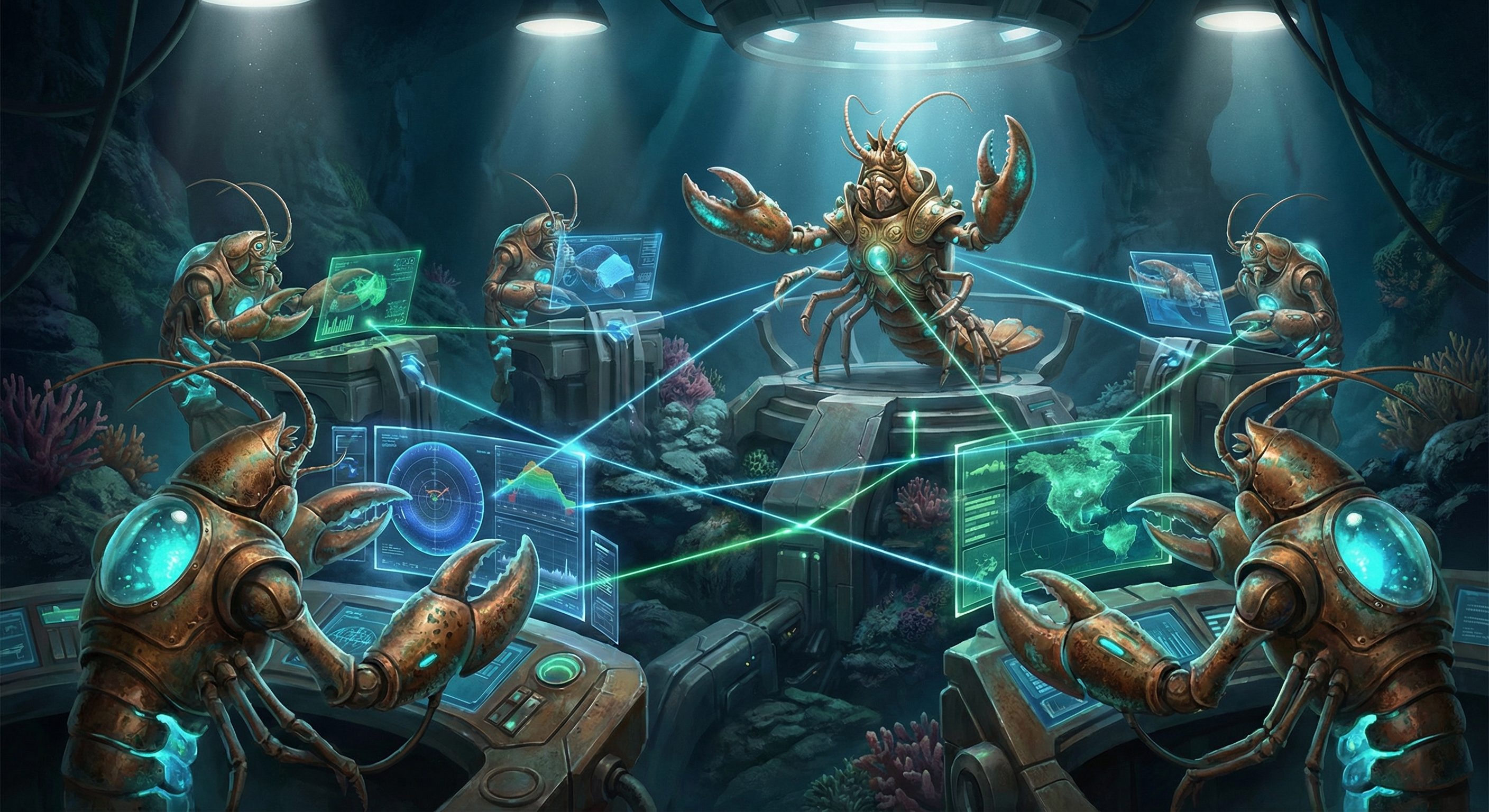
The most common pattern. One "orchestrator" agent breaks down tasks and delegates to specialized sub-agents. The orchestrator doesn't do the work—it coordinates.
User Request
     │
     ▼
Orchestrator Agent
  ├── analyzes task
  ├── identifies sub-tasks
  └── delegates to specialists
     ├── ResearchAgent → web search, synthesis
     ├── WritingAgent → drafts and edits content
     ├── DataAgent → queries databases, runs analysis
     └── SchedulingAgent → manages calendar, sends invites
The orchestrator collects outputs and assembles the final response. This is essentially how A2A's client/remote agent model works at the protocol level.
Pattern 2: Pipeline (Sequential)
Tasks flow through agents in sequence, each transforming the output of the previous one.
RawDataAgent → CleaningAgent → AnalysisAgent → ReportingAgentSimpler than orchestration, but can't parallelize. Good for workflows where each step depends strictly on the previous output.
Pattern 3: Debate / Critic Pattern
Multiple agents independently tackle the same problem, then a critic agent evaluates their outputs or they debate to a consensus. Useful for high-stakes decisions where diverse perspectives reduce error.
Pattern 4: Autonomous Agents with Shared State
Agents work independently on subtasks but read/write to shared state (a database or memory store). Coordination happens through the state rather than direct agent-to-agent messaging.
Framework Comparison
LangGraph (LangChain)
Mental model: Graph-based state machine. Nodes are functions or agents, edges are transitions, state is explicitly managed.
Best for: Complex workflows with branching logic, loops, and precise state management requirements. Excellent when you need to define exactly what happens in each step and when.
from langgraph.graph import StateGraph, END
from typing import TypedDict

class State(TypedDict):
    task: str
    research: str
    draft: str
    final: str

graph = StateGraph(State)
graph.add_node("research", research_node)
graph.add_node("draft", draft_node)
graph.add_edge("research", "draft")
graph.set_entry_point("research")
workflow = graph.compile()Tradeoffs: Explicit control is powerful but verbose. More setup than higher-level frameworks. Excellent for production deployments where predictability matters.
CrewAI
Mental model: Role-based teams. Define agents with roles, goals, and backstories. Define tasks. Assign agents to tasks. The framework handles execution.
Best for: Workflows that map naturally to organizational structures—a "research analyst," "content writer," and "editor" working on a report. High-level, fast to prototype.
from crewai import Agent, Task, Crew

researcher = Agent(
    role="Senior Research Analyst",
    goal="Find accurate, comprehensive information on the given topic",
    tools=[search_tool, web_scraper]
)

crew = Crew(agents=[researcher, writer], tasks=[research_task, write_task])
result = crew.kickoff()Tradeoffs: Less control than LangGraph. Harder to debug when things go wrong.
Microsoft AutoGen
Mental model: Conversational agents. Agents talk to each other in turn, with configurable termination conditions.
Best for: Tasks that benefit from back-and-forth dialogue between agents—brainstorming, iterative code review, debate-based reasoning.
from autogen import AssistantAgent, UserProxyAgent

assistant = AssistantAgent(
    name="assistant",
    system_message="You are a helpful AI assistant. Reply TERMINATE when done.",
    llm_config={"model": "gpt-4"}
)

user_proxy.initiate_chat(
    assistant,
    message="Write and test a Python function that validates email addresses"
)Tradeoffs: Conversational style is flexible but less structured. Better for creative/iterative tasks than strict workflows.
Practical Migration Path
Moving from single-agent to multi-agent isn't a one-step change. Here's a reasonable progression:
- 1.Identify the bottlenecks — Profile your single agent. What tasks take longest? Where does performance degrade?
- 2.Carve out the first specialist — Extract the most clearly separable concern into its own agent.
- 3.Add explicit handoffs — Define how the orchestrator delegates to the specialist.
- 4.Add observability before adding complexity — Instrument what you have before adding more agents.
- 5.Add specialists incrementally — Each addition should solve a specific, observed problem.
The Cross-Organizational Dimension
Everything above assumes agents within a single organization. But the most interesting territory is what happens when agents from *different* organizations need to collaborate.
This is where the A2A protocol becomes essential. An internal multi-agent architecture using LangGraph or CrewAI can expose an A2A-compatible interface to the outside world, allowing external agents to interact with your agent mesh as if it were a single remote agent.
Your internal agent fleet becomes a service. External agents (from partners, customers, platforms) interact with the A2A endpoint. What happens inside—however many specialist agents, whatever frameworks—is invisible to them.
Common Pitfalls
Over-engineering: Not everything needs five agents. Start with the minimum viable number.
Shared state corruption: Multiple agents writing to shared state creates race conditions. Use append-only logs or per-agent workspaces where possible.
Infinite loops: Without proper termination conditions, agents can bounce tasks back and forth indefinitely. Budget token counts, max iterations, or time limits.
Context loss between hops: Each agent handoff risks losing important context. Be explicit about what gets passed and in what format.
Cost explosion: Multi-agent systems multiply LLM calls. Benchmark costs before going to production.
The transition from single to multi-agent is one of the most impactful architectural decisions in AI engineering right now. Done well, it unlocks capabilities that simply aren't achievable with a single agent. Approach it incrementally, instrument everything, and let actual bottlenecks drive the decomposition.